

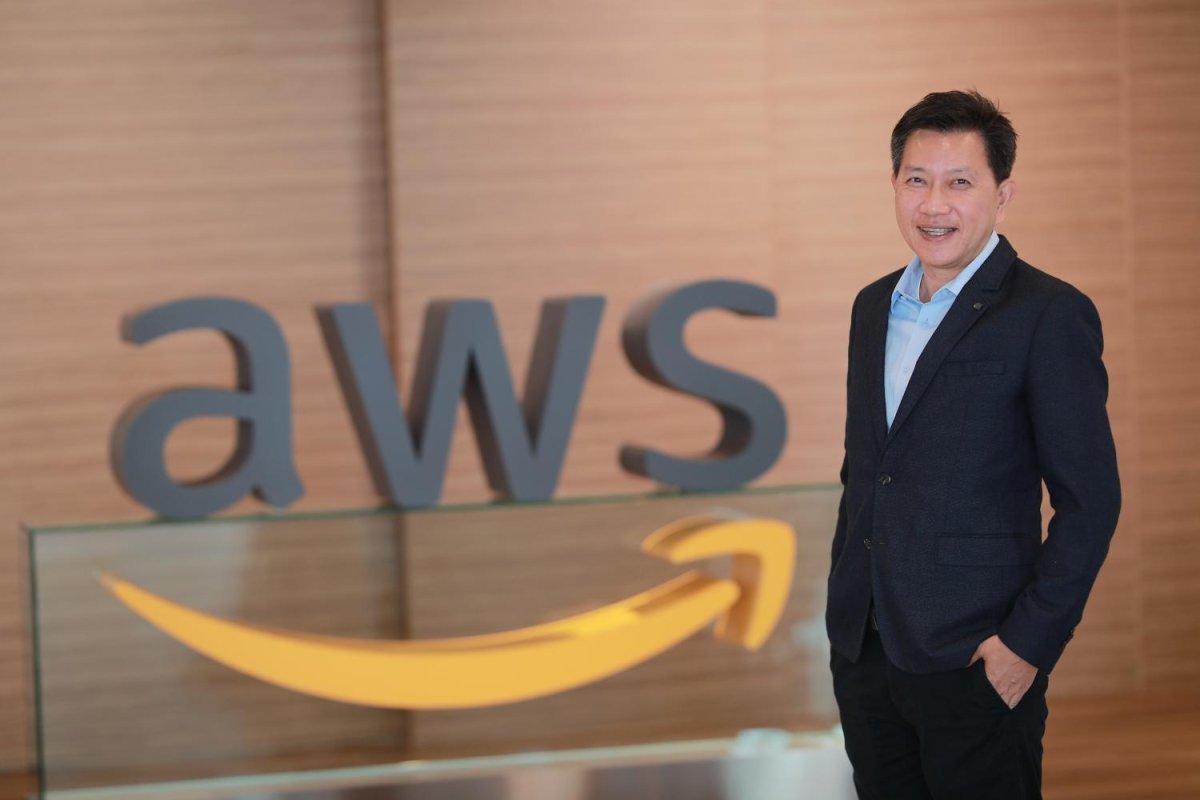
Photo Credit: Bangkok Post
Amazon Web Services (AWS) Thailand is positioning its local cloud region as a future hub for artificial intelligence, aiming to meet rising enterprise demand for more advanced “frontier AI agents” capable of performing complex tasks with minimal human input.
The move reflects a shift among businesses from using basic AI tools to adopting enterprise-grade automation systems. With Thailand’s digital economy expected to grow 4.2% this year to reach 5.6 trillion baht, cloud infrastructure is increasingly seen as a key foundation for digital development.
Vatsun Thirapatarapong, country manager of AWS Thailand, said the presence of multiple cloud providers would encourage more Thai organisations to adopt cloud technologies.
AWS, the cloud computing arm of Amazon, launched the AWS Asia-Pacific (Thailand) Region in January 2025 as part of a broader commitment announced in 2022 to invest more than US$5 billion in Thailand by 2037. The investment is expected to create thousands of jobs and has already brought more than 120 cloud services to the local market.
According to Mr Vatsun, AWS aims to deliver the same global standard of cloud services in Thailand while helping develop the country into an AI hub. He also encouraged businesses to carefully assess cloud providers to ensure they offer reliable global standards, cost efficiency and a wide range of services.
AI adoption among Thai businesses has been accelerating rapidly. Around 150,000 companies used AI in 2024, increasing adoption to 32% from 24% the previous year. By 2025, more than 600,000 businesses had integrated AI into their operations, signalling a shift from competitive advantage to operational necessity.
In 2026, AWS Thailand plans to focus on expanding the use of its local cloud region, developing agentic AI platforms, strengthening partnerships and scaling AI through partner networks.
Mr Vatsun said the next stage of AI development will involve autonomous AI agents capable of handling complex workflows, automating tasks such as software development, security testing and operational troubleshooting.
These “frontier agents” are designed to operate independently, coordinate with other AI systems and complete multi-step tasks over extended periods. To support enterprise use, they will incorporate features such as long-term memory and strict policy controls.
To support this shift, AWS is introducing the Amazon Nova model family, which offers specialised capabilities such as advanced text-to-speech and custom AI model training, while also promoting the modernisation of legacy systems through the adoption of open-source technologies to improve performance and reduce costs.