

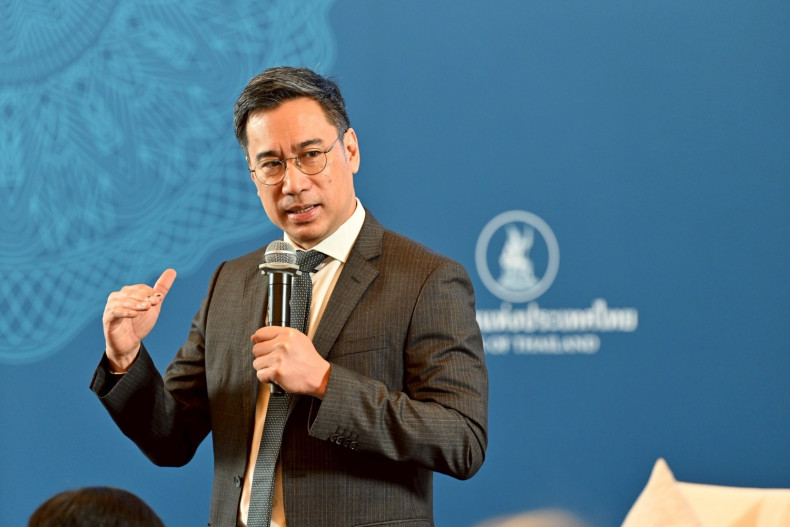
Photo Credit: Bank of Thailand
Thailand’s economic growth in the coming year faces heightened risks due to potential delays in the budget, stemming from ongoing political deadlock, according to outgoing Bank of Thailand governor Sethaput Suthiwartnarueput.
In an interview with Bloomberg Television in Bangkok on Wednesday, Mr. Sethaput expressed concern about the outlook for 2026, which the central bank currently projects to grow by 1.7%, down from roughly 2% this year. However, he warned that this forecast is subject to risk if political uncertainties cause delays in approving next year’s budget.
With interest rates already at a multi-year low, the central bank’s ability to further ease monetary policy is limited, he noted. If the economic situation worsens significantly, a rate cut could become necessary.
He also warned that Thailand’s credit rating might come under threat unless political risks are addressed and some fiscal consolidation occurs in the near term.
As Mr. Sethaput discussed these concerns, the risks he highlighted appeared increasingly imminent. Following the opposition People’s Party’s endorsement of a minority government led by Bhumjaithai, the ruling Pheu Thai Party announced it was seeking royal approval to dissolve the House of Representatives, paving the way for a general election.
If an election is called, it’s expected to take place in late October or early November. Without an election, a Bhumjaithai-led minority government would be required to dissolve the House within four months, per its agreement with the People’s Party.
Mr. Sethaput, 60, is set to end his five-year term at the end of this month. His career includes roles at McKinsey & Company in New York and the World Bank in Washington before joining Thailand’s central bank, where he has served as governor through multiple changes of finance ministers and prime ministers.
Experts have warned that prolonged political deadlock could further weaken Thailand’s already fragile economy, which has been impacted by US trade tariffs, a decline in tourism, and record-high household debt levels—the highest in Southeast Asia.
The government forecasts annual growth of around 2% for this year, which is less than half the pace of neighboring countries like Indonesia and the Philippines.
The Bank of Thailand’s Monetary Policy Committee has lowered the benchmark interest rate by a total of 100 basis points since October, bringing it to 1.50%. Bank officials have stated that while policy remains accommodative, any further easing would only occur if the economy faces a “significant material deterioration” or unexpected shocks.
Thailand’s headline inflation has remained in negative territory since April and has consistently fallen short of the central bank’s 1% to 3% target range throughout the year.
Vitai Ratanakorn, a seasoned banker and advocate for rate cuts, is set to assume the role of governor on October 1. He has publicly supported significant, sustained reductions in the policy rate to stimulate the stagnant economy, emphasizing that commercial banks should pass on the reductions to consumers.
Although the MPC’s rate decisions are made by majority vote among its seven members, Mr. Vitai’s influence is expected to shape its future direction. He will chair the committee for the first time on October 8.
Previously, Mr. Vitai headed the Government Savings Bank, where he played a key role in efforts to provide financial relief to small businesses and households heavily affected during the pandemic.