

Asian stock markets advanced on Friday as investors interpreted U.S. President Donald Trump’s recent tariff threats as a strategic move aimed at gaining concessions in ongoing trade negotiations ahead of the August 1 deadline.
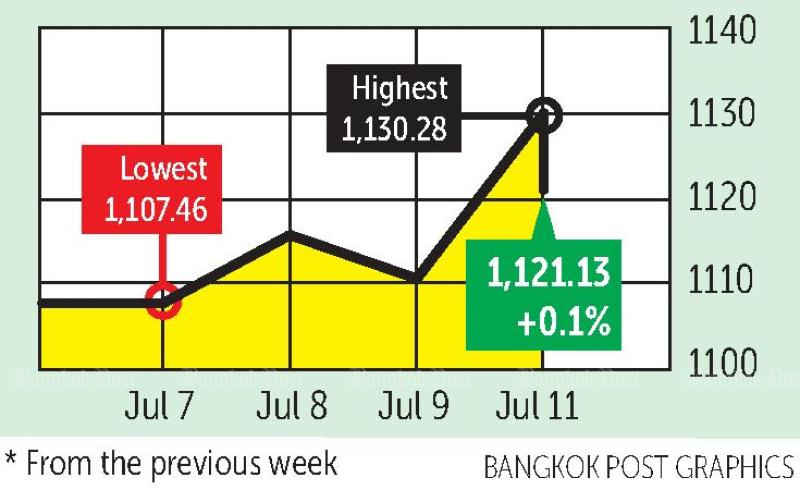
This week, the SET index fluctuated between 1,107.46 and 1,130.28 points, ultimately closing at 1,121.13 — a 0.1% increase from the previous week. The daily trading volume averaged 30.88 billion baht.
Retail investors were net buyers, purchasing 2.99 billion baht, while foreign investors bought 742.30 million baht. Conversely, institutional investors were net sellers, offloading 3.18 billion baht, with brokerage firms selling 558.25 million baht.
Credit Bangkok post
Europe is preparing for a letter from President Trump outlining the proposed tariff rates for U.S. imports. This follows recent threats—one among several—by Trump to impose a 35% tariff on Canadian goods.
Earlier, the U.S. sent tariff notices to 14 countries, including Thailand, which was informed it would face a 36% rate—unchanged from April—and higher than rates for Indonesia (32%), Malaysia (25%), and Vietnam (20%). These tariffs are set to take effect on August 1 if trade agreements are not reached.
Trump also announced plans to impose an additional 10% tariff on countries aligning with what he calls the “anti-American policies” of the BRICS nations, of which Thailand was accepted as a partner this year.
Additionally, the U.S. aims to restrict AI chip shipments to Malaysia and Thailand to prevent the export of advanced semiconductors to China.
In metals markets, Trump’s threat of a 50% tariff on copper imports sparked a record rise in New York futures and a drop in the global benchmark price.
Meanwhile, Bitcoin continued its record-breaking run, surpassing $117,000 on Friday, driven by increased risk appetite and sustained institutional demand as mainstream financial players adopt the cryptocurrency.
Shares of Nvidia increased by 2.2% on Wednesday, becoming the first company to reach a market value of $4 trillion, thanks to its leadership in AI chip technology.
TSMC, the world’s largest contract chipmaker, forecasts record profits for this year as it ramps up semiconductor production to meet soaring AI demand. Its second-quarter sales surged 48% year-on-year to $11.6 billion.
Samsung Electronics projected its April-June operating profits would halve compared to the previous year, reaching 4.6 trillion won ($3.3 billion), citing U.S. export restrictions on advanced AI chips to China.
Minutes from the June 17-18 Federal Reserve meeting indicate most members see two additional interest rate cuts this year, believing tariffs’ impact on inflation will be minimal and temporary.
OPEC+ agreed to a larger-than-expected oil supply increase of 548,000 barrels per day in August, raising concerns about oversupply amid fears of demand slowdown due to U.S. tariffs. Overall, the group has increased production by 1.9 million barrels per day over the past five months.
Chinese vehicle sales reached 2.1 million units in June, a 7% rise from the previous year’s peak of 1.9 million in 2022, driven by government trade-in subsidies encouraging purchases.
China’s producer price index declined more than expected in June, dropping 3.6% year-on-year after a 3.3% decrease in May—the largest decline since July 2023.
Fast Retailing, owner of Uniqlo, reported profits of 146.7 billion yen ($1 billion) for the three months ending in May—a 3% decrease year-on-year—due to a 5% decline in Chinese revenue.
Goldman Sachs revised upward its forecast for Asian stocks, citing a more favorable macroeconomic environment and clearer tariff outlooks. The target for the MSCI Asia Pacific ex-Japan Index over the next 12 months is set at 700, representing a 3% gain and a 9% return in dollar terms.
Canada’s Foreign Minister Anita Anand aims to finalize a free trade agreement with ASEAN promptly, seeking to bolster economic ties amid U.S. tariffs.
Thailand is reportedly offering zero tariffs on U.S. goods in certain categories, particularly technology and energy products that won’t significantly impact domestic producers, as part of a revised proposal to reduce its current 36% tariff rate.
The Bank of Thailand forecasts that the country’s economy will grow less than 2% over the next 18 months, mainly due to pressures from U.S. tariff policies.
Thailand may lose roughly 200 billion baht in exports this year if U.S. tariffs remain in the 25-36% range, according to the University of the Thai Chamber of Commerce.
The Thai cabinet withdrew a controversial bill to legalize casinos amid widespread public opposition and concerns over the coalition’s reduced majority after Bhumjaithai Party joined the opposition.
Thailand’s headline inflation rate decreased by 0.25% in June compared to the previous year, after a 0.57% decline the month prior. Core inflation stood at 1.06%.
The government approved a flat fare of 20 baht for all eight Bangkok electric train lines, starting October 1, though implementing this will require billions in subsidies.
The Consumer Confidence Index for June dropped to 52.7—its lowest in 28 months—reflecting uncertainties from the trade war and political instability.
Deputy Finance Minister Paopoom Rojanasakul stated that approximately 40-50 billion baht remains from a 157 billion baht stimulus fund, which could be used to assist those affected by higher U.S. tariffs.
In the first half of 2025, Malaysia surpassed China as Thailand’s largest source of inbound tourists, as arrivals
On Monday, China releases quarterly GDP, trade, and unemployment data, while Japan updates industrial production. Tuesday sees the US monthly inflation report, and Wednesday features UK inflation, US producer prices, oil inventories, and Japan trade figures. Thursday includes euro zone inflation, US retail sales, and manufacturing data.
Locally, Fetco and ThaiBMA hold the Investment Forum 2025 on Monday, and Tris Ratings hosts a Thai credit outlook seminar on Tuesday.
Asia Plus Securities (ASPS) has identified listed companies that earn over 10% of their revenue from US exports: COCOCO (24%), ITC (50%), TU (40%), DELTA (26%), and KCE (24%). These stocks make up about 10% of Thailand’s total market capitalization.
Bloomberg data shows 85 companies, representing 63% of the SET market cap, are expected to report a combined net profit of 176 billion baht—down 2% QoQ and 1.6% YoY. Recommended stocks for gradual accumulation include ADVANC, BTG, KTC, MTC, TIDLOR, SPRC, CBG, CKP, and BCH.
InnovestX Securities advises monitoring US trade negotiations and domestic political developments, with PTT, CPALL, and CBG highlighted as key stocks.
TECHNICAL VIEW: Tisco Securities sees support at 1,100 points and resistance at 1,160, while InnovestX Securities also identifies support at 1,100 and resistance at 1,155.