

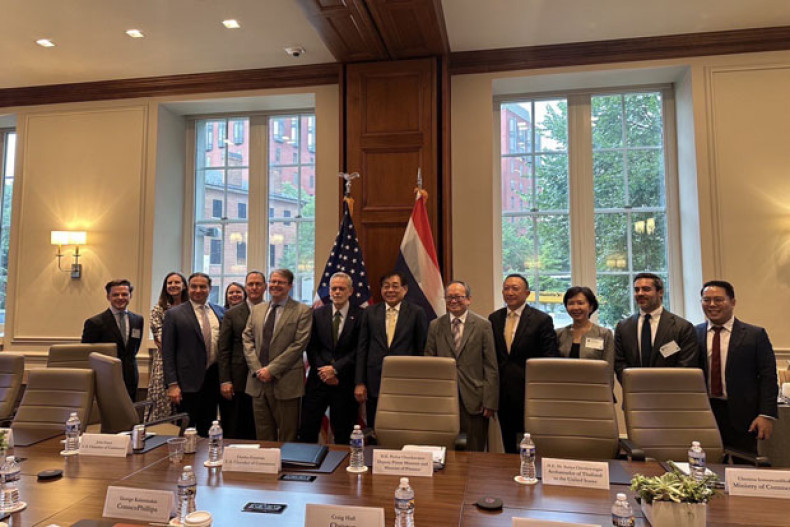
Photo Credit: @PichaiChun X account
U.S. President Donald Trump announced that Washington will begin sending letters to countries on Friday, detailing the specific tariff rates they will face on imports into the United States. This marks a significant departure from earlier promises to negotiate numerous individual trade deals.
Recognizing the complexity involved in negotiating with over 170 nations, Trump explained before departing for Iowa on Thursday that the letters would be sent in batches to ten countries at a time, specifying tariff rates such as 20% to 30%.
“We have more than 170 countries, and how many deals can you make?” Trump commented. “They’re much more complicated.”
The President indicated that he anticipates “a couple” of more detailed agreements with certain countries following the announcement of a trade deal with Vietnam on Wednesday. Nevertheless, he expressed a preference for notifying most countries of a specific tariff rate rather than engaging in lengthy negotiations.
Trump’s remarks highlight the difficulties in finalizing trade agreements that cover tariffs and non-tariff barriers, such as bans on agricultural imports.
Top aides previously indicated in April that they aimed to conclude 90 trade deals within 90 days—a goal met with skepticism from trade experts familiar with the extensive and time-consuming nature of such negotiations.
Treasury Secretary Scott Bessent told Bloomberg Television that around 100 countries are expected to face a reciprocal tariff of 10%, and predicted a flurry of trade deal announcements before a July 9 deadline, when tariffs could increase sharply.
If tariffs of 10% are applied to 100 countries, this would be fewer than the 123 jurisdictions initially slated by the Trump administration for a 10% reciprocal tariff—mostly small countries and territories like Australia’s uninhabited Heard and McDonald Islands.
The administration’s initial plan, announced on April 2, included sweeping reciprocal tariffs ranging from 10% to 50%, though most countries temporarily had their rates reduced to 10% to facilitate negotiations until July 9.
Many nations with an initial 10% duty have yet to engage in negotiations, with Britain being an exception after reaching a deal in May to maintain a 10% rate and secure preferential treatment in sectors such as automobiles and aircraft engines.
Currently, key trading partners are subject to higher tariffs: 20% for the European Union, 26% for India, and 24% for Japan. Countries with no trade negotiations with the U.S. face even higher reciprocal tariffs, including 50% for Lesotho, 47% for Madagascar, and 36% for Thailand.
On Wednesday, Trump announced an agreement with Vietnam, stating that U.S. products would be able to enter Vietnam duty-free.