

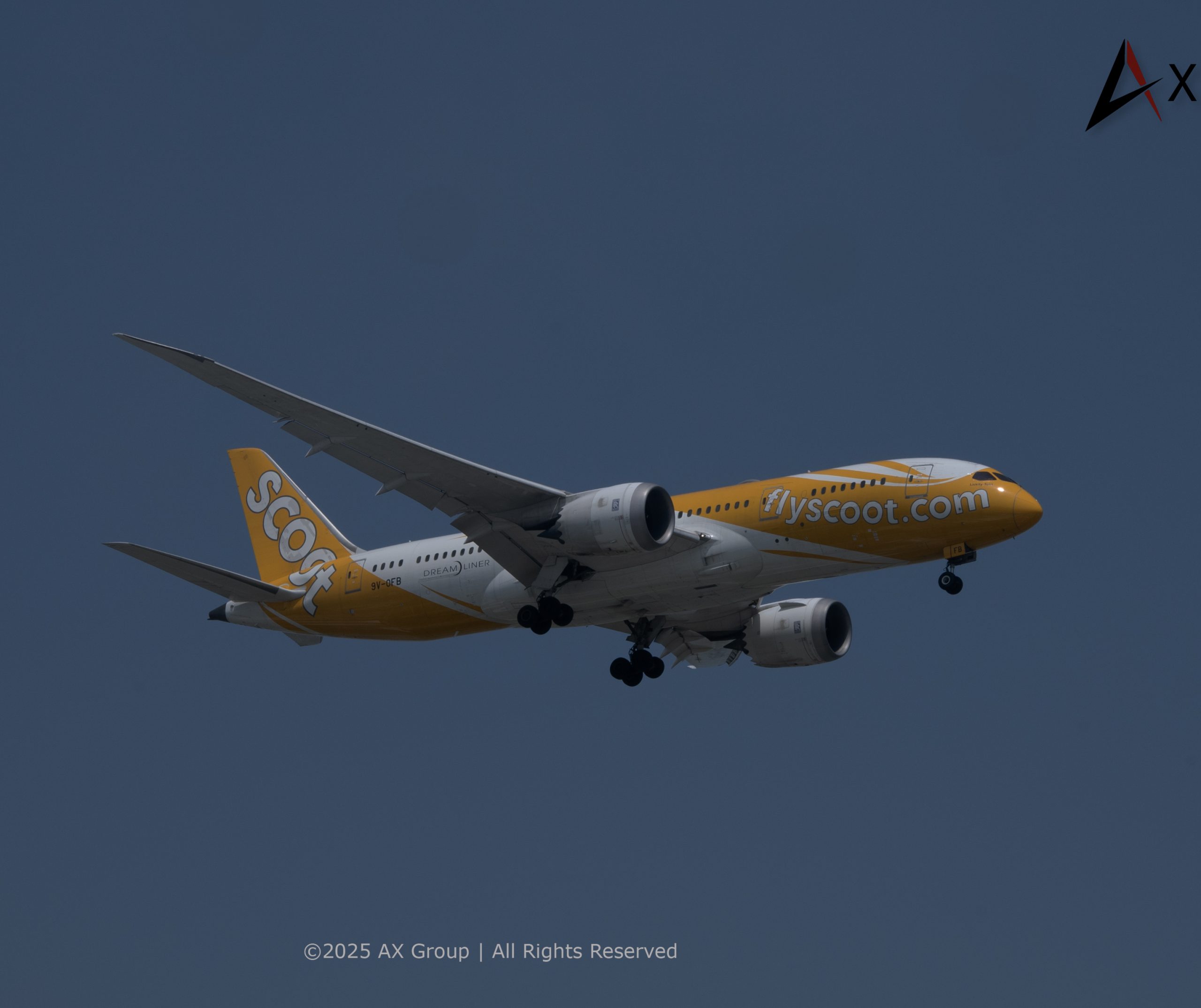
Scoot, the low-cost arm of Singapore Airlines, continues to see solid travel demand from regions unaffected by the Gulf conflict, with operations spanning seven destinations in Thailand. The airline is also preparing to expand into secondary regional cities, supported by the addition of nine Embraer E190-E2 aircraft.
Lee Yong Sin, Scoot’s vice-president for pricing, ancillaries and sales, said inbound passenger traffic to Thailand — served by more than 120 weekly flights — increased by 15% in the fiscal year ending March 2026. Outbound demand from Thailand also rose by 10% over the past year.
While the airline is closely monitoring developments in the Middle East, only its Jeddah route has been temporarily suspended until April 16 due to safety concerns. Mr Lee noted that demand and forward bookings from unaffected regions, including Southeast Asia, North Asia and Australia, remain largely stable, although fares have been adjusted slightly to reflect higher fuel costs.
Scoot has adopted the same fuel hedging strategy as its parent company, Singapore Airlines, with approximately 47% coverage between January and March.
For the Songkran holiday period, the airline expects load factors to average between the high 80% and low 90% range. Booking windows have shortened to one to two weeks ahead of departure.
“Demand remains strong and we are cautiously optimistic. At the same time, we must stay competitive with other low-cost carriers and adjust pricing in line with market conditions,” Mr Lee said.
Scoot currently operates a fleet of 60 aircraft, comprising Boeing 787 wide-body jets, Airbus A320 narrow-body aircraft and Embraer E190-E2 regional jets, which seat 112 passengers. The E190-E2 allows the airline to better match capacity with demand, particularly for secondary and tertiary cities. This includes its recently launched Singapore–Chiang Rai route, which began on January 1 with five weekly flights, as well as operations at airports with shorter runways such as Samui.
The airline remains focused on Southeast Asia, serving seven destinations in Thailand, 15 in Indonesia, 12 in Malaysia and five in the Philippines.
Expansion of long-haul European routes is not expected in the near term, as Scoot’s 24 wide-body aircraft are currently fully utilised. Prior to the conflict, routes to Vienna and Athens were already operating at around 90% load factors, and while demand has increased, limited aircraft availability restricts further growth.
Any future expansion of the wide-body fleet will depend on additional aircraft orders by the Singapore Airlines Group, Mr Lee added, noting that global aircraft supply remains tight, with delivery lead times stretching up to five years.
In Thailand, Scoot’s customer base is primarily made up of tech-savvy travellers aged 25 to 45, with around half of all bookings made via the airline’s website or mobile app.