

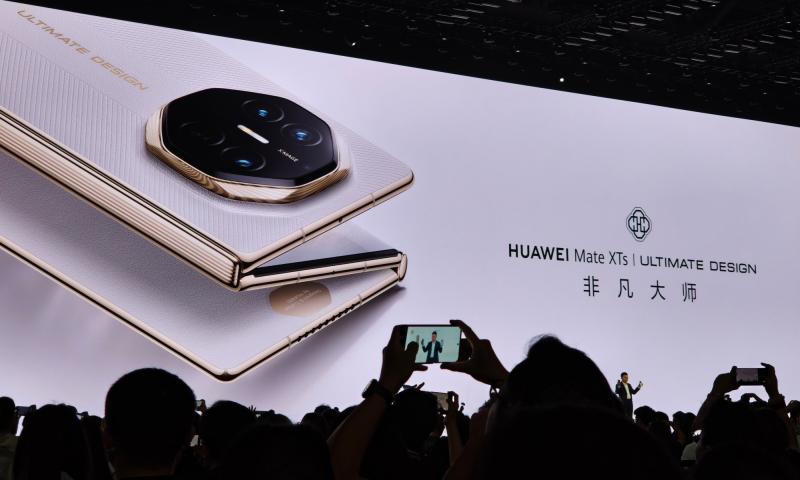
Photo Credit: South China Morning Post
Powered by Huawei’s self-developed Kirin 9020 chipset and operating on the company’s proprietary HarmonyOS ecosystem, the Mate XTs offers a 36% performance boost, according to Richard Yu Chengdong, Huawei’s consumer business group chairman, during Thursday’s launch event in Shenzhen.
The device features three screens measuring between 3.6mm and 4.75mm thick, which unfold into a 10.2-inch display. It weighs 298 grams, the same as the Mate XT. Available in four colors, the 256GB version starts at 17,999 yuan (approximately 81,000 baht), with higher storage options priced at 19,999 and 21,999 yuan—roughly 2,000 yuan less than comparable Mate XT models.
The Mate XTs comes with Huawei’s new M-Pen 3 stylus, designed for navigation, note-taking, and sketching.
For the first time, Huawei has enabled the installation of PC-designed apps on a smartphone, including WPS—the Chinese alternative to Microsoft Office—and Wind, a local competitor to Bloomberg Terminal, Yu announced.
He also noted that HarmonyOS 5, Huawei’s latest ecosystem, has reached 14 million users.
Preorders for the Mate XTs began Thursday evening, with deliveries expected to start next Friday.
The device highlights Huawei’s confidence in the foldable market, where it remains the sole provider of trifold models—devices with three screens that fold to expand into a larger display.
Earlier this year, Samsung showcased its concept trifold devices, the Flex G and Flex S, at the Mobile World Congress in Barcelona. China’s Xiaomi and Honor have also filed patents for similar designs in 2022 and 2011, respectively.
Huawei shipped nearly 500,000 units of the Mate XT in the first half of this year, increasing its share of China’s foldable phone market to 75%, up 32 percentage points from the previous year, according to IDC.
The Mate XTs launch comes just days ahead of Apple’s annual fall event, where the tech giant is anticipated to introduce the iPhone 17 lineup. Many expect Apple to unveil its first foldable iPhone next year, with a curved-glass model reportedly planned for 2027 to mark the product’s 20th anniversary.
While Apple saw sales growth in mainland China, Hong Kong, and Taiwan during the June quarter, helped by local consumer subsidies, IDC predicts a 1.9% decline in iPhone shipments in China this year due to ongoing competition from Huawei and an economic slowdown.